

The Greater Toronto Area (GTA) housing market opened 2026 at a measured pace. January activity reflected a combination of early‑year seasonality and continued buyer caution, resulting in lower sales volumes and softer pricing compared to last year. While the headlines may suggest slowdown, the underlying story is more nuanced — one of adjustment, improving balance, and emerging opportunity.
This update combines January 2026 market statistics with broader insights from the 2026 TRREB Market Outlook & Year in Review, offering context on where the market stands today and what may lie ahead.
January 2026 GTA Market Snapshot
January’s numbers highlight a market that is resetting rather than retreating.
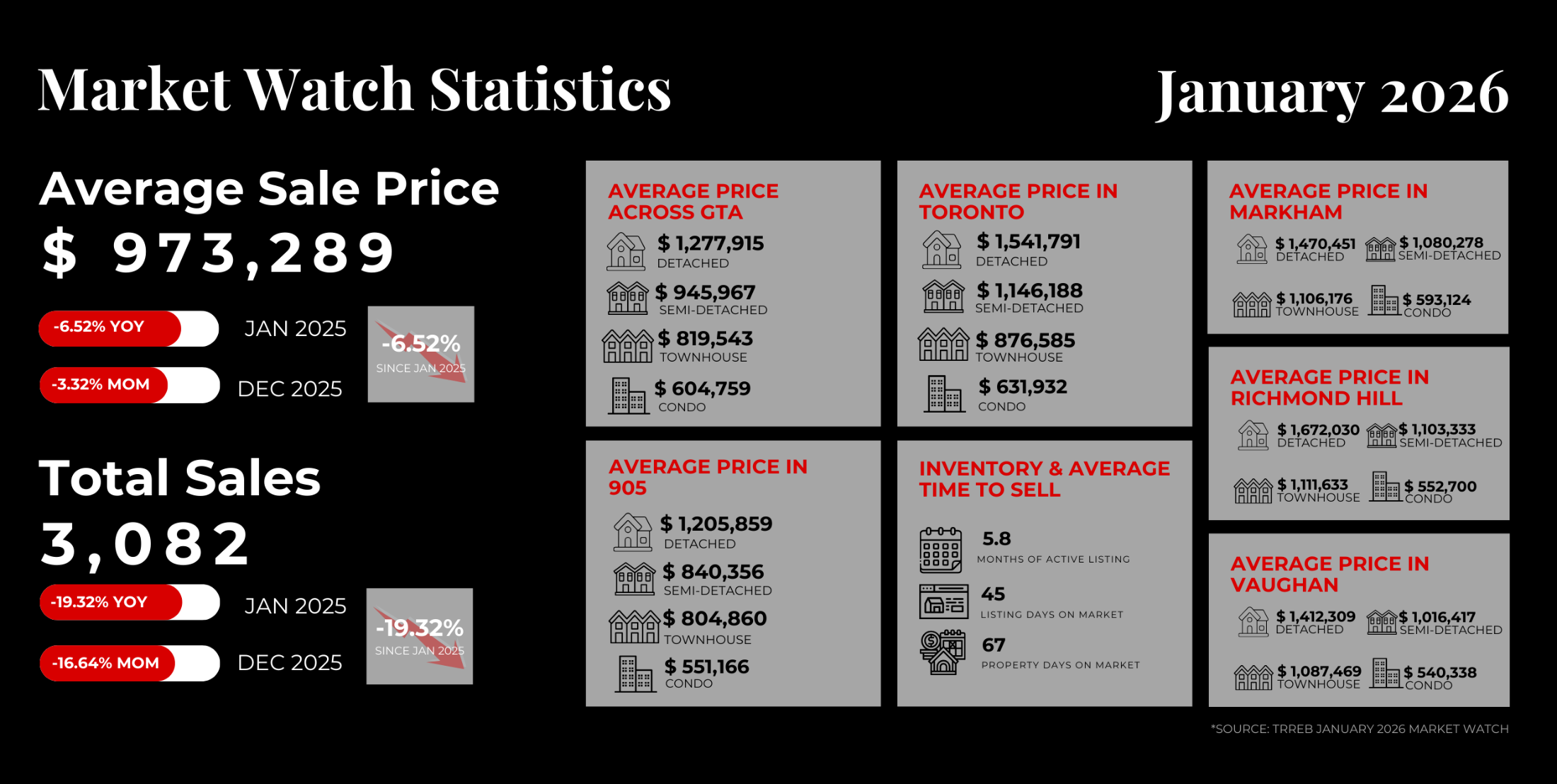
Average Home Price: $973,289 (down 6.5% year‑over‑year)
Home Sales: 3,082 transactions (down 19.3% year‑over‑year)
New Listings: 10,774 (down 13.3% year‑over‑year)
MLS® HPI Benchmark: down approximately 8% year‑over‑year
Sales activity slowed more sharply than new listings, reflecting cautious buyer sentiment amid ongoing economic uncertainty. However, pricing adjustments have been gradual rather than abrupt, signalling a market that is stabilizing rather than under stress.
What’s Driving the Market Right Now
1. Buyer Caution Remains a Key Theme
Entering 2026, many buyers continue to take a wait‑and‑see approach. Concerns around job security, cost of living, and broader economic conditions have tempered urgency — particularly in higher‑priced segments of the market. This has resulted in longer decision cycles and fewer competitive bidding situations.
2. Affordability Has Improved, But Confidence Lags
One of the most notable shifts coming out of 2025 was improving affordability, driven by price adjustments and more stable borrowing conditions. While this has meaningfully improved purchasing power, confidence has not yet fully returned. As history shows, affordability improvements often lead demand — but with a delay.
3. Inventory Is Rebalancing
Although new listings were lower year‑over‑year in January, inventory levels remain more balanced compared to recent peak years. Sellers are facing a more discerning buyer pool, leading to more realistic pricing strategies and renewed importance of preparation, presentation, and positioning.
Insights from the 2026 TRREB Market Outlook
The 2026 TRREB Market Outlook & Year in Review reinforces several important themes shaping the year ahead:
A Gradual Recovery, Not a Rapid Rebound: Market improvement is expected to be incremental, tied closely to economic stability and employment confidence.
Pent‑Up Demand Is Building: Many households delayed moves in 2024 and 2025. Once confidence improves, this demand is expected to re‑enter the market.
Condos and Entry‑Level Homes Remain Sensitive: These segments continue to feel affordability pressures but may benefit most quickly as conditions stabilize.
Commercial and Investment Activity Remains Selective: Investors are focused on fundamentals — cash flow, location quality, and long‑term viability — rather than short‑term appreciation.
Overall, TRREB’s outlook points toward a more balanced market environment in 2026, with healthier negotiating conditions and fewer extremes on either side.
What This Means for Buyers in 2026
For buyers, today’s market offers conditions that haven’t been available in years:
More choice and less competition
Greater leverage during negotiations
Fewer pressure‑driven decisions
Prepared buyers who understand neighbourhood‑level pricing and act strategically are well‑positioned to benefit as the market continues to normalize.
What This Means for Sellers
Sellers in 2026 must adjust expectations and strategies:
Accurate pricing is critical
Presentation and marketing matter more than ever
Homes that are well‑positioned continue to sell, even in slower conditions
While the market no longer rewards optimism‑based pricing, it does reward clarity, preparation, and professional guidance.
Looking Ahead: A Market Defined by Balance
January 2026 reinforces a key message: the GTA housing market is not in decline — it is recalibrating. With improved affordability, evolving inventory levels, and pent‑up demand waiting on the sidelines, the foundation for gradual recovery is forming.
As always, real estate outcomes remain highly localized. Understanding how these broader trends translate at the neighbourhood and property‑type level will be essential for anyone considering a move in 2026.
If you’re quietly watching the market or planning ahead this year, staying informed — not reactive — will be your biggest advantage.