Latest Blog Posts

GTA December 2025 Market Report: A Year of Affordability Paves the Way for a 2026 Recovery

Posted by Paul Lee on Jan 15, 2026

Author: Real Insights Group Team | Date: January 15, 2026 The 2025 Greater Toronto Area (GTA) housing ...

What the Latest Bank of Canada Hold and U.S. Fed Rate Cut Could Affect Canadian Homeowners in 2026

Posted by Paul Lee on Dec 12, 2025

If you’re making real estate decisions in 2026, this month brought two important updates: The Bank of ...

GTA November 2025 Real Estate Market Report: Sales Down, Opportunities Rising for Buyers

Posted by Paul Lee on Dec 08, 2025

Author: Real Insights Group Team | Date: December 08 2025 The Greater Toronto Area (GTA) housing market ...

📰 The 2025 Fraser Institute Rankings Are Here: What the Top Schools Mean for Your Property Value

Posted by Paul Lee on Dec 04, 2025

Author: Real Insights Group Team Date: December 2, 2025 The release of the Fraser Institute’s annual ...

GTA Housing Market Sees Price Decline in October 2025

Posted by Paul Lee on Nov 19, 2025

The latest October 2025 stats from the Toronto Regional Real Estate Board (TRREB) paint a clear picture: ...

GTA Real Estate Market Analysis: September 2025 – Momentum Builds as Affordability Improves

Posted by Paul Lee on Oct 08, 2025

The Greater Toronto Area (GTA) housing market experienced a notable shift in September, driven by improving ...

RSS

What the Latest Bank of Canada Hold and U.S. Fed Rate Cut Could Affect Canadian Homeowners in 2026

If you’re making real estate decisions in 2026, this month brought two important updates:

  1. The Bank of Canada held its overnight rate at 2.25%, and

  2. The U.S. Federal Reserve cut its key interest rate again.

Both moves impact confidence, borrowing costs, and buyer behaviour — but in different ways.

Here’s a clear breakdown to help you understand what’s actually happening, without the noise.


Bank of Canada Holds at 2.25% — Why That Matters

The Bank of Canada kept its policy rate unchanged, signaling that it sees the current level as appropriate to keep inflation close to 2% while helping the economy adjust to post‑pandemic structural changes.

Key Takeaways for Canadian Homeowners + Buyers

  • Inflation remains near target: CPI is sitting close to 2.2%, and core inflation is still around 2.5%.

  • Economic growth is uneven: Q3 surprised to the upside (2.6% growth), but much of it was driven by trade volatility, not domestic demand.

  • Labour market improving slowly: Jobs are recovering but hiring intentions are still soft.

  • Expect stability over the next few months: Unless major data shifts, the BoC is signaling that rates are likely to remain stable.

This hold suggests we’re entering a period where Canadians can plan with a little more confidence — something we haven’t had in a while.


The U.S. Federal Reserve Cuts Rates — And Why Canada Should Still Pay Attention

The Federal Reserve reduced its key rate again, bringing it to roughly 3.6% — the lowest in nearly three years.

Markets largely expected the move, which is why the reaction was modest: the S&P hovered near record highs, and the Dow climbed.

Why this matters for Canadians

  • Fed cuts can ease global financial conditions.

  • U.S. economic shifts often spill over into Canada through trade, capital flows, and investor sentiment.

  • A more accommodative U.S. stance can indirectly influence future decisions by the Bank of Canada — but not immediately.

But there’s a caveat:

The Fed is deeply divided internally. Some members want more cuts to support hiring, while others worry inflation is still too high. Their uncertainty could extend into early 2026.


What This Means for Toronto Buyers and Sellers in 2026

1. Mortgage Stability Is Returning

With the Bank of Canada pausing and inflation softening, buyers can expect more predictable borrowing conditions — something we haven’t enjoyed for years.

2. Detached and Luxury Homes Will See Renewed Interest

Educated professionals, families, and investors often make decisions based on confidence.

Rate stability tends to bring these buyers back earlier than most segments.

3. Sellers Should Plan Ahead — Smartly

If you’re preparing your home for a 2026 sale, focus on value‑driven updates, not trends.

Financially minded buyers (especially those in finance and tech) look for longevity, not design fads.

4. Expect a More Balanced Spring Market

With both central banks signaling “steady as she goes,” 2026 could see healthier activity — still competitive in key pockets, but with less volatility.


My Perspective as a Toronto Real Estate Advisor

After 19 years in this business, I’ve seen how markets behave when central banks pause, cut, or hold.

Periods like this tend to reward the people who take a calm, strategic approach — not the ones who rush.

If you’re making a move in 2026, the most important thing is clarity:

What do the numbers mean for your budget, your home, and your timeline?

That’s always the conversation worth having.


Thinking About a Move This Year?

If you want a straightforward breakdown of what today’s rates mean for your next purchase or sale — without pressure — I’m always here to help.

Read

GTA November 2025 Market Update: A Buyer-Friendly Winter Continues

The latest data from the Toronto Regional Real Estate Board (TRREB) shows that the Greater Toronto Area housing market remained buyer-friendly in November 2025, with sales, new listings, and average prices all down from a year earlier. Many buyers continue to wait on the sidelines, looking for stronger economic signals before making a move.

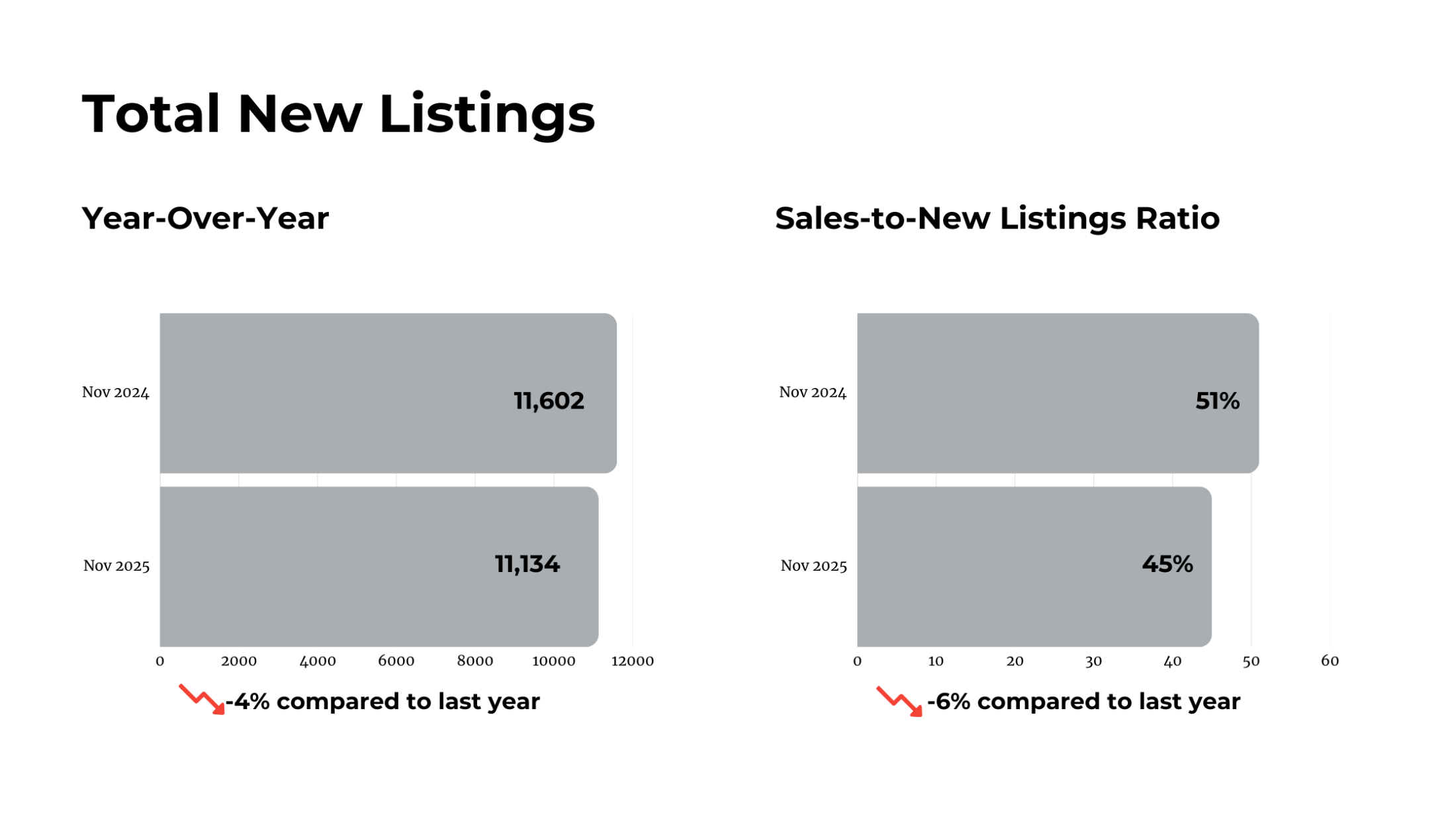
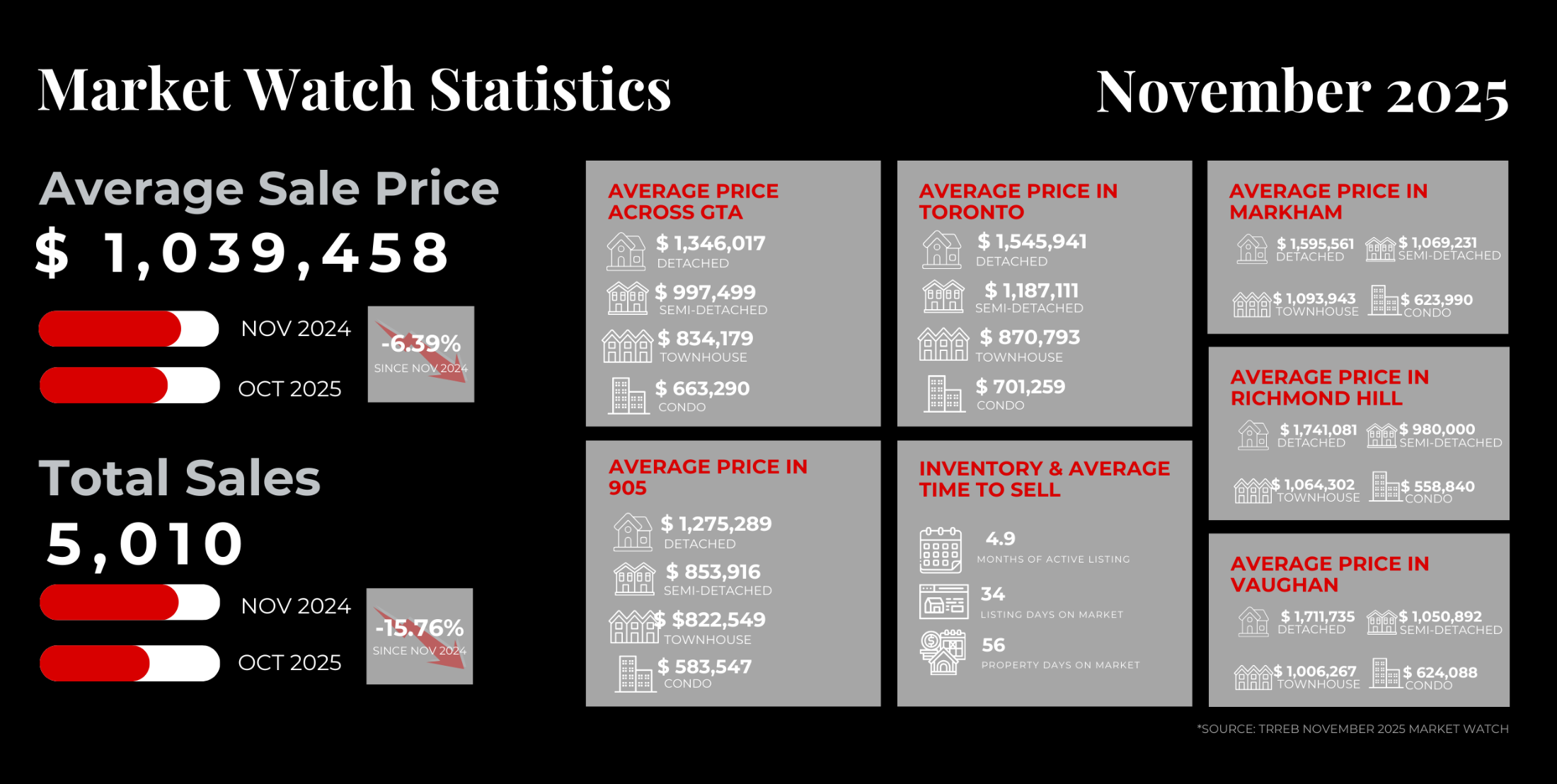
Home sales fell 15.8% year-over-year, while new listings dipped by 4%. The average selling price declined to $1,039,458, down 6.4% annually. Despite the softer numbers, month-to-month indicators show stability: prices held steady, and the average home price even edged up slightly from October.

Encouraging November employment data and stronger-than-expected economic growth point to improving consumer confidence heading into 2026. TRREB leaders note that a resilient job market and major infrastructure investments may help bring more buyers back into the market next year.

For now, buyers continue to benefit from a well-supplied market, offering more choice and less competition than in previous years. Sellers who price strategically are still securing results, especially in high-demand neighbourhoods.

👉 Want monthly market insights and expert real estate guidance? Subscribe to my newsletter and stay ahead of the GTA market trends.

Read

GTA November 2025 Real Estate Market Report: Sales Down, Opportunities Rising for Buyers

Author: Real Insights Group Team | Date: December 08 2025

The Greater Toronto Area (GTA) housing market continued to recalibrate in November 2025 as home sales, new listings, and average selling prices declined compared to the same period last year. The trend reflects a market where many would-be buyers are waiting for stronger economic signals before re-entering the competition.

But beneath the softer year-over-year numbers lies an important story: employment strength, improving economic indicators, and stable month-to-month pricing suggest the foundation for recovery in 2026 is quietly forming.


📉 Sales and Listings Decline as Buyers Wait for Economic Clarity

According to TRREB, REALTORS® reported 5,010 home sales across the GTA in November 2025 — a 15.8% decrease from November 2024. New listings totaled 11,134, down 4% year-over-year.

This cooling is less about lack of interest and more about buyer psychology.

“There are many GTA households who want to take advantage of lower borrowing costs and more favourable selling prices. What they need most is confidence in their long-term employment outlook,”

TRREB President Elechia Barry-Sproule

Her comment captures the sentiment driving today’s market: demand exists, but confidence needs to catch up.


📊 Month-to-Month Numbers Show Early Signs of Stabilization

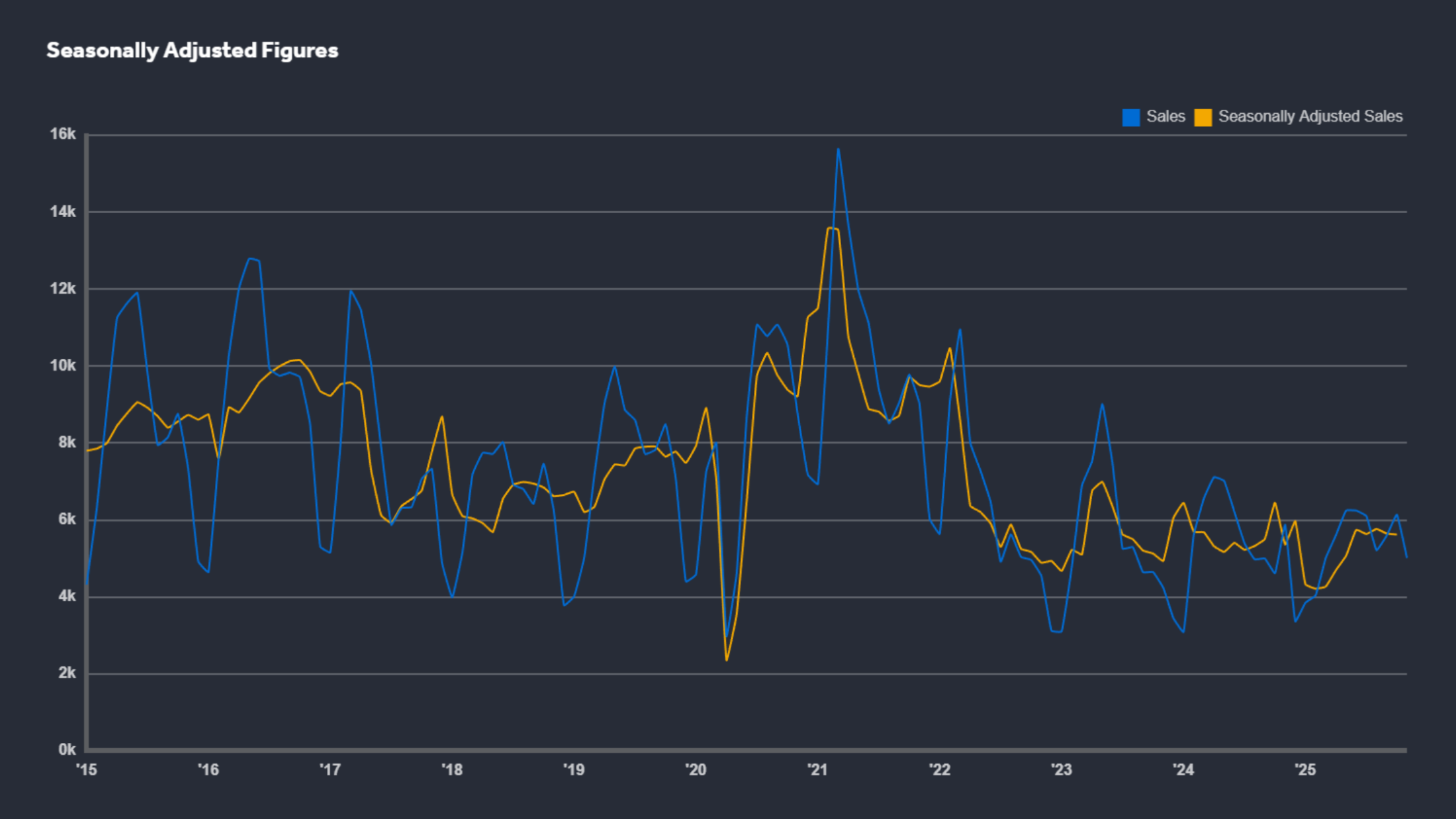
While year-over-year figures are softer, seasonally adjusted data paints a more balanced picture:

  • Sales dipped only slightly from October to November

  • New listings edged lower, keeping inventory healthy but not excessive

  • MLS® HPI Composite was marginally down from October

  • Average price inched upward month-over-month

In other words: we’re not seeing a downward slide — we’re seeing a market finding its footing.


🏘️ Prices Down Annually — But Holding Steady Month-to-Month

The MLS® Home Price Index (HPI) Composite Benchmark fell 5.8% year-over-year, reflecting the impact of cautious buyers and broader economic uncertainty.

The average selling price reached $1,039,458, down 6.4% from November 2024.

However, on a monthly basis, prices remained stable, signalling that sellers are adjusting realistically while buyers remain selective.


📈 Why 2026 Could See a Rebound: Economic Data Turns Positive

November delivered something the housing market desperately needed: good economic news.

  • Employment numbers beat expectations

  • Economic growth outperformed forecasts

  • Canada showed resilience against trade-related challenges

  • Infrastructure plans announced in late 2025 are poised to stimulate jobs and long-term housing demand

“More certainty on the trade front coupled with positive economic impacts of recently announced infrastructure projects could improve homebuyer confidence moving forward,”

Jason Mercer, TRREB Chief Market Analyst

If this momentum holds, it could create the backdrop for a more confident buyer pool in 2026, particularly in the spring and early fall cycles.


🏗️ A Well-Supplied Market — But Not Indefinitely

Despite moderating demand, the GTA continues to benefit from healthy resale inventory, giving buyers more choice than in previous tight markets.

However, TRREB issues a caution:

“As this inventory is absorbed, new construction is required to fill the housing pipeline,”

John DiMichele, TRREB CEO

The call is clear:

To stabilize prices long-term and support population growth, Ontario needs more housing — not only condos, not only detached homes, but the missing middle in between.

Expect government incentives and development activity to be major conversations heading into 2026 and beyond.


🔑 The Bottom Line for Buyers and Sellers

For Buyers:

You are currently in one of the most favourable purchasing environments in recent years:

  • More listings

  • Reduced competition

  • Stable month-to-month prices

  • Lower borrowing costs compared to peak cycles

As employment data improves, you may not see this level of choice for long.

For Sellers:

While year-over-year prices are lower, stable monthly pricing suggests the market is nearing a baseline. Sellers who price strategically are still securing strong results — particularly in segments with limited supply (detached homes in prime school zones, family-oriented neighbourhoods, and transit-connected communities).


Looking Ahead to 2026

The GTA housing market is transitioning, not declining. Economic strength, job growth, and infrastructure investment will be the biggest catalysts heading into the new year.

If confidence continues to build, 2026 may mark the beginning of a more active and competitive market cycle.


Thinking About Buying or Selling in 2026?

We provides data-backed, neighbourhood-specific advice for buyers, sellers, and investors across the GTA.

If you’d like a custom breakdown of market trends in your area, contact us if want to know where the real opportunities are emerging.

Read

New property listed in Toronto C08

Excited to share new listing at 6008 197 Yonge Street in Toronto. See details here

Penthouse At Massey Tower. Sought After Studio/Jr 1 Br Model W/ Lg Balcony, Bright South Exposure W/ ***Breathtaking Unobstructed Panoramic Lake & City Views!!*** Soaring 10' Ceilings. Nook For Bedroom. World Class Amenities Incl Fitness Ctr, Sauna W/ Juice Bar, Piano Bar, Cocktail Lounge, Terrace & Party Room. Steps To Subway, Restaurants, Shops & Eaton Centre! Heart Of Downtown, Financial District, Entertainment, Universities All Close By.

Read

📰 The 2025 Fraser Institute Rankings Are Here: What the Top Schools Mean for Your Property Value

Author: Real Insights Group Team Date: December 2, 2025

The release of the Fraser Institute’s annual school rankings is always a marquee event in the Ontario real estate calendar. While educators look at the scores, we at the Real Insights Group look at the zones.

The 2025 Report Card on Ontario’s Secondary Schools has just dropped, and the results confirm a trend we’ve been tracking for years: York Region and Oakville are solidifying their status as the premier academic (and investment) corridors in the province.

Here is our breakdown of the 2025 winners and the real estate markets they anchor, providing data-driven commentary for the discerning buyer.


🏆 The "Perfect" Score Club (10/10)

This year, four schools achieved a perfect 10/10 rating. If you own property in these catchment areas, you are sitting on a highly liquid asset—a home with a maximum "school zone premium."

  • St. Robert Catholic High School (Thornhill)

  • St. Therese of Lisieux Catholic High School (Richmond Hill)

  • St. Augustine Catholic High School (Markham)

  • St. Michael’s Choir School (Toronto)

The Real Estate Insight from Real Insights Group:

York Region Dominance: Three of the four top schools are in York Region (Thornhill, Richmond Hill, Markham). This concentration of excellence is a primary driver for the price resilience we see in these suburbs. Detached homes in the St. Robert and St. Therese zones command significant premiums because they offer the "suburban dream"—large lots paired with elite public education that rivals private tuition.

The Downtown Outlier: St. Michael’s Choir School in downtown Toronto is a unique case. Located in the Church-Yonge Corridor, this area offers a surprising "value" entry point. While the school is specialized, the surrounding real estate is condo-heavy, with median prices significantly lower than the freehold-heavy zones of York Region.


📈 The Heavy Hitters (9.0+)

The full list of schools scoring 9.0 or higher identifies the next tier of "blue chip" neighborhood’. Since multiple schools share a score, this list includes all 19 schools tied for the top 18 ranks, from 10.0 down to 9.0.

York Region (The Undisputed Heavyweight)

York Region continues to be the undisputed heavyweight champion of public education in Ontario. The density of high-ranking schools here translates directly into high demand for homes.

  • Pierre Elliott Trudeau (Markham) – 9.5: Consistently anchors the high-demand Berczy Village market.

  • Bur Oak Secondary (Markham) – 9.3: A key driver for the Wismer community, popular with families seeking newer detached homes.

  • Bayview Secondary (Richmond Hill) – 9.2: Famous for its IB program, this school keeps demand in the Rouge Woods area perpetually high.

  • Markville Secondary (Markham) – 9.2: Serves the central Markham area, supporting values near the Markville Mall corridor.

  • Unionville High School (Unionville) – 9.0: A staple of academic excellence, sustaining high property values in the Old Town and surrounding areas.

  • Thornlea Secondary (Thornhill) – 9.0: Adds another strong option for Thornhill buyers, specifically in the East Willowdale/Thornhill border area.

Oakville (Halton Region)

Oakville's reputation as a family haven is backed by hard data. It is rare to see this many top-tier schools in a single municipality.

  • Abbey Park9.3: Located in the prestigious Glen Abbey neighbourhood.

  • Iroquois Ridge9.3: Anchors the north-east Oakville market, known for larger executive homes.

  • Gaétan-Gervais9.3: A top-tier French-language option that expands the buyer pool in its catchment.

  • Oakville Trafalgar9.2: The historic powerhouse serving south-east Oakville, often associated with the luxury custom home market.

City of Toronto

While the city is vast, academic excellence is concentrated in specific, highly desirable pockets that savvy investors target.

  • Ursula Franklin Academy9.7: A highly specialized school boosting desirability in the High Park/Junction area.

  • Cardinal Carter Academy for the Arts9.3: Located in North York, this specialized arts school draws talent from across the city, boosting local rental and freehold demand.

  • Bloor Collegiate Institute9.2: Significant achievement for this west-end school, signalling growth in the Dufferin-Grove/Bloordale area.

  • Lawrence Park Collegiate9.1: Serves one of Toronto’s most affluent neighbourhoods, reinforcing the stability of property values in Lawrence Park.

  • Malvern Collegiate Institute9.1: A consistent high-performer anchoring the popular Beaches and Upper Beaches communities.

  • Leaside High School9.1: A top-tier school driving high property demand in the Leaside

City of Mississauga

Mississauga's only entry in the 9.0+ club is an independent school, which significantly influences buyer activity in its central region.

  • Olive Grove School9.4: A top-tier independent Islamic school, attracting families to the central Mississauga area seeking this elite institution.


🚀 The "Improvers": Where to Look for Future Growth

As investors, we always look for the up-and-coming areas. The report highlighted schools like Georges-P-Vanier in Hamilton and Central Technical School in Toronto as fast improvers.

Strategy: Buying in a district with a rapidly improving school can be a smart long-term play. As the school's reputation rises, demographic shifts often follow, leading to gentrification and property appreciation that outpaces the market average. The Real Insights Group tracks these changes closely to help clients secure future equity.


🔑 The Bottom Line

In Ontario, a school district is never just about education—it’s about equity. The 2025 rankings reaffirm that Markham, Richmond Hill, and Oakville remain the "blue chip" stocks of the school-zone real estate market. For buyers, this sometimes means more competition in these catchments. For sellers, it means you hold a powerful negotiating card.

Want to know exactly which homes fall into any particular School Catchment? Contact the Real Insights Group today for a custom list of available properties in Ontario's top-ranked school zones.

Source: Fraser Institute Report Card on Ontario’s Secondary Schools 2025

Read
This website may only be used by consumers that have a bona fide interest in the purchase, sale, or lease of real estate of the type being offered via the website. The data relating to real estate on this website comes in part from the MLS® Reciprocity program of the PropTx MLS®. The data is deemed reliable but is not guaranteed to be accurate.