

Uncertainty around inflation, borrowing costs and the economy kept many Greater Toronto Area (GTA) home buyers on the sidelines in October, according to the latest figures from the Toronto Regional Real Estate Board (TRREB).
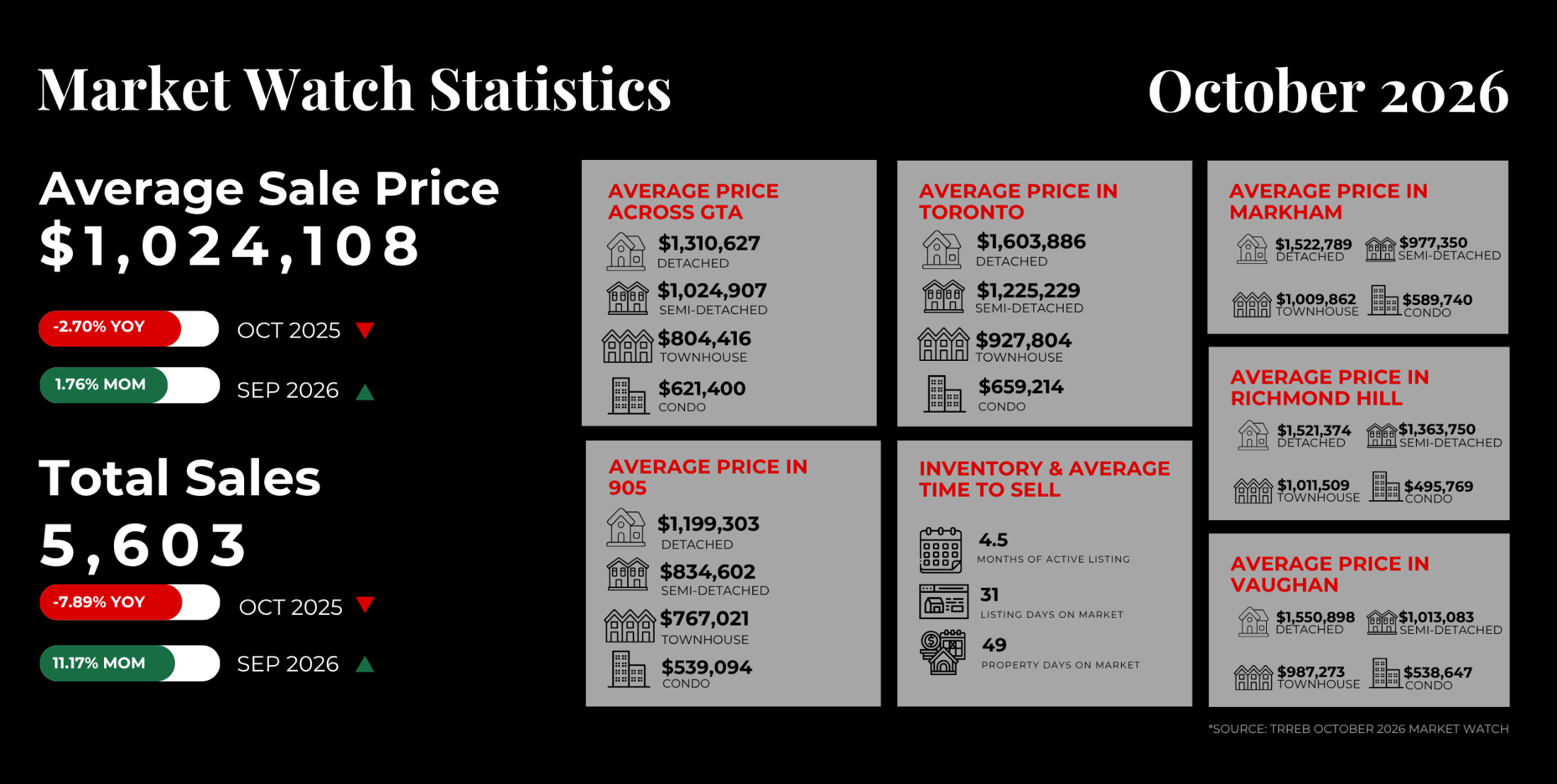
GTA REALTORS® reported 5,603 home sales through TRREB’s MLS® System in October 2026—down 7.9 per cent compared to October 2025.
Fewer buyers were ready to commit last month, even though monthly mortgage payments for an average priced home remain far more manageable than they were in 2023 and 2024.
For anyone who has purchased a home in the GTA—or considered doing so—this cautious mood will likely feel familiar.
Here is what stood out to me in the October data, and what it could mean for buyers and sellers as we move toward 2027.
What Did the October 2026 Numbers Show?
Let’s start with the headline figures.
There were 5,603 sales in October 2026, down 7.9 per cent from a year earlier.
New listings entered into the MLS® System totaled 14,173—down 11.9 per cent year-over-year.
That means new listings fell by a larger percentage than sales did.
There is also a more encouraging detail. On a seasonally adjusted basis, both home sales and new listings were up month-over-month compared to September 2026.
Seasonal adjustment smooths out the normal ups and downs of the calendar, which makes it easier to see whether momentum is truly changing from one month to the next.
So while activity was lower than a year ago, it moved higher compared to September.
What Is Happening With Prices?
The MLS® Home Price Index (MLS® HPI) Composite benchmark was down 4.3 per cent year-over-year in October 2026. The MLS® HPI is designed to track the price of a typical home, which makes it a useful complement to the average price.
The average selling price came in at $1,024,108—down 2.7 per cent compared to a year ago.
But there is another important part. On a seasonally adjusted basis, both the MLS® HPI Composite and the average selling price edged up month-over-month compared to September 2026.
To be clear, one month does not make a trend. But it is a data point worth watching in the months ahead.
Why Are Buyers Still on the Sidelines?
TRREB President Daniel Steinfeld pointed to two developments that could change the mood.
If a Canada-U.S. trade deal is reached, GTA residents could gain a clearer picture of the economic outlook. Combined with a resolution to the conflict in the Middle East, this could help ease concerns about inflation and economic uncertainty, strengthen consumer confidence and renew interest in homeownership as we move into 2027.
That’s an important point. Buying a home is one of the largest financial decisions most people will ever make, and when the outlook feels unclear, it is natural to want more information before committing.
Of course, waiting for certainty is not always possible for every household. A growing family, a new job or a change in plans does not always follow the economic calendar.
Is Affordability Better Than It Might Appear?
Monthly mortgage payments for an average priced home have edged up compared to a year ago. But they remain much more affordable than the payments required in 2023 and 2024.
TRREB Chief Information Officer Jason Mercer explained why.
GTA home buyers have continued to benefit from substantial negotiating power on price over the past year. Borrowing costs have increased on the back of higher inflation, but lower selling prices have helped mitigate the impact on monthly mortgage payments.
That means lower selling prices have helped offset higher borrowing costs, keeping affordability in check.
For buyers, that negotiating power is a significant consideration.
What About the Longer-Term Picture?
TRREB CEO John DiMichele offered an important reminder. While the ownership market continues to experience shorter-term volatility, the permanent population in our region will continue to grow.
He also pointed to recent policy announcements, including HST rebates and development charge reductions. These should help bring a greater diversity of ownership and rental supply online in the medium term, so new families can be housed affordably.
This is an area I’m particularly interested in through my work with the Government Relations Committee. Supply that matches the needs of a growing population is one of the most meaningful parts of the housing conversation.
But the key words are “medium term.”
Policy change rarely happens overnight.
There Are Still Important Questions to Answer
Of course, there is another side to the discussion.
The developments Mr. Steinfeld described are possibilities, and it is difficult to predict when—or if—they will arrive. Until there is more clarity on trade, inflation and global events, some buyers may continue to wait.
And with fewer new listings coming to market than a year ago, some sellers may be weighing whether to list now or wait for stronger conditions.
Neither decision is wrong. Each depends on a household’s own timeline, finances and goals.
A Market Still Looking for Clarity
October was a month of caution. Sales, new listings and prices were all lower than a year ago, yet the seasonally adjusted numbers showed sales, new listings, the MLS® HPI Composite and the average selling price all edging up from September.
At the same time, lower selling prices have helped keep monthly payments in check, and the longer-term case for housing in the GTA remains supported by a growing population.
I’ll be following these trends closely, particularly any developments on trade, inflation and housing policy.
In the meantime, if you’re considering buying, now is a good time to understand your budget, your monthly payments and your upfront costs, so you are prepared when the right home appears. If you’re considering selling, thoughtful pricing and preparation matter, especially in a market where buyers have had room to negotiate.
Every situation is different. If you’d like to talk through what these numbers mean for your plans, feel free to reach out. I’m always happy to have a conversation.
Paul Lee
REALTOR® | Greater Toronto Area
This article is for general informational purposes only and is based on market statistics released by TRREB on November 4, 2026. Figures and market conditions may change, and policy announcements referenced here may not yet be fully implemented. It is not intended as legal, financial or real estate advice. Buyers and sellers should seek independent legal and financial advice on mortgages, taxes, rebates and closing costs for their own circumstances.