

October 15, 2026
The fall real estate market is typically a time when activity picks up after the summer. But September's numbers suggest that many GTA homebuyers are still taking a wait-and-see approach.
According to the Toronto Regional Real Estate Board (TRREB), there were 5,040 home sales in September 2026, down 9% from a year earlier. New listings also declined, falling 14.4% year-over-year.
What's interesting is that both buyers and sellers appear to be holding back.
Prices have become more affordable compared to last year, and there are buyers who would like to make a move. But concerns about the economy, job security, inflation and borrowing costs continue to influence their decisions.
So what do these numbers tell us about the market, and what should buyers and sellers be thinking about?
September 2026 GTA Real Estate Market at a Glance
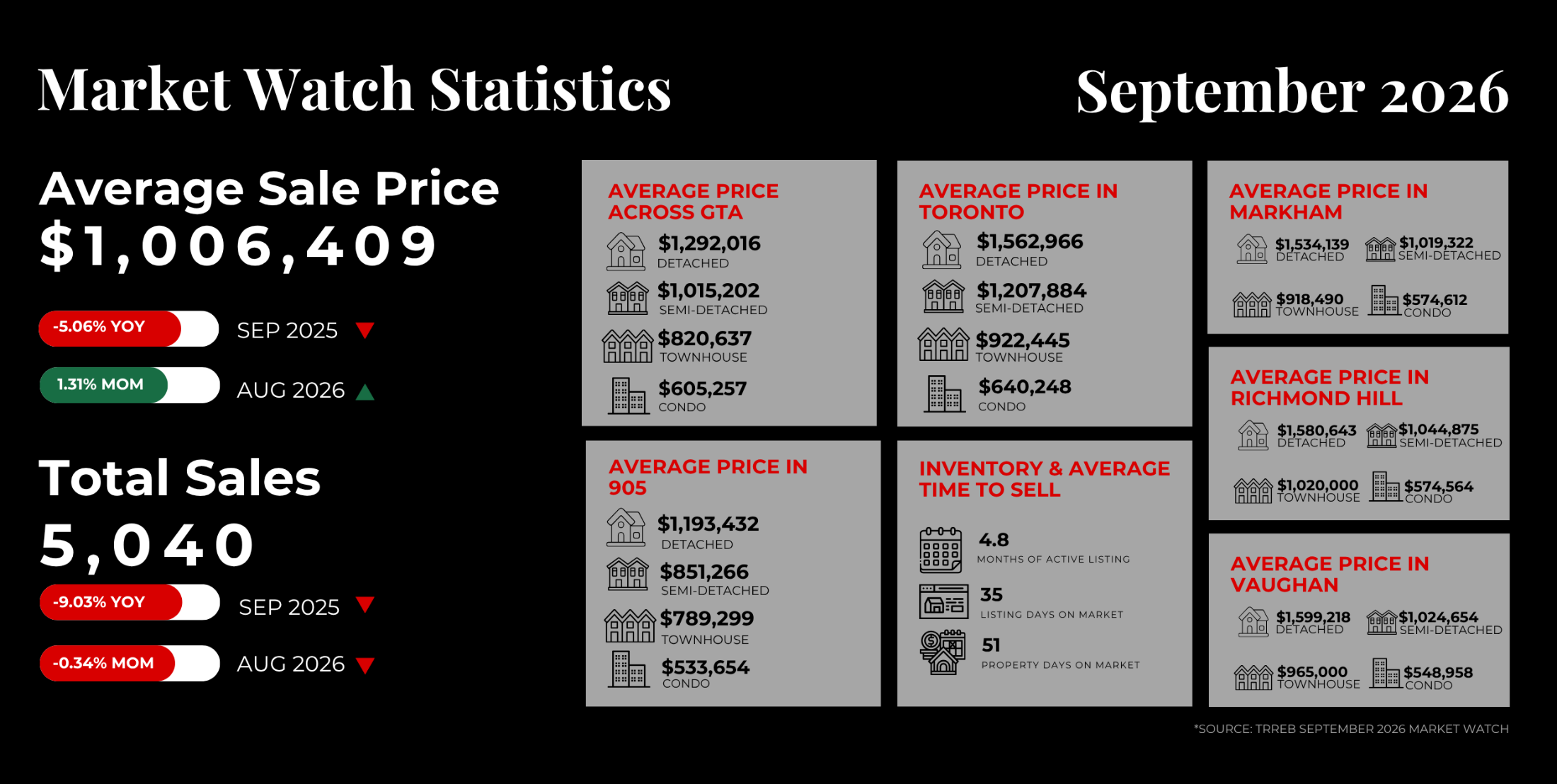
Here are the key numbers from TRREB's September market report:
Both sales and new listings also declined compared to August on a seasonally adjusted basis.
The average selling price fell 5.1% to $1,006,409, while the MLS® Home Price Index (HPI) Composite benchmark declined 4.7%.
The distinction between these two price measures is worth understanding. The average selling price can be influenced by the types of homes that sell in a given month, while the HPI is designed to track changes in the value of a typical home over time.
Both measures point to lower prices compared to a year ago.
But as I often remind clients, the GTA isn't one single real estate market. A detached home in Markham, a townhouse in North York and a downtown Toronto condo can all experience very different market conditions.
The overall statistics provide useful context, but local inventory, recent comparable sales and buyer activity are what really matter when making a decision.
Buyers Are Interested, But Confidence Remains a Challenge
One of the more interesting observations from TRREB's September report came from Chief Information Officer Jason Mercer, who pointed to the substantial pent-up demand that still exists in the GTA.
Many households want to purchase a home and recognize that prices have become more attractive. The challenge is having enough confidence in their financial outlook to move forward.
And that makes sense.
Buying a home is a significant financial commitment. Even when prices are lower, uncertainty about employment, household expenses or future borrowing costs can make people hesitant.
For someone considering a $1 million purchase, a lower price is certainly helpful. But so is knowing that their income is secure and their monthly payments will remain manageable.
Affordability matters, but confidence matters just as much.
This helps explain why we're seeing buyers continue to research properties, monitor prices and explore their options without necessarily being ready to make a purchase.
It doesn't mean demand has disappeared. Some of it is simply being delayed.
Of course, there is no guarantee that all this pent-up demand will return at once, or that prices will move higher when confidence improves. Much will depend on the broader economy and how market conditions evolve.
Housing Affordability Is Also a Policy Issue
Another important part of September's market commentary was the attention given to housing policy and the upcoming municipal elections.
TRREB President Daniel Steinfeld highlighted how decisions made by municipal governments over the next four years will influence housing affordability, supply and the cost of homeownership.
TRREB CEO John DiMichele also reiterated the need to reduce barriers to homeownership, including Toronto's Municipal Land Transfer Tax, while opposing any expansion of the tax into other parts of the GTA and Simcoe County.
This is an issue that's particularly meaningful to me.
As a member of TRREB's Government Relations Committee, I've had the opportunity to be involved in discussions and advocacy efforts aimed at improving housing affordability and addressing some of the barriers facing homebuyers and homeowners.
One of those longstanding issues is Toronto's Municipal Land Transfer Tax.
Unlike buyers in most other Ontario municipalities, Toronto purchasers pay both provincial and municipal land transfer taxes. This can add tens of thousands of dollars to the upfront cost of purchasing a home.
Recently, Toronto mayoral candidate Brad Bradford announced a proposal to waive the Municipal Land Transfer Tax on the first $1.1 million of the purchase price of a primary residence.
I wrote about that proposal in a recent blog post, including why it could be meaningful not only for first-time buyers, but also for growing families looking to move up and homeowners considering downsizing.
The proposal has not been implemented, but it's encouraging to see an issue that TRREB has advocated on for many years becoming part of the broader public discussion.
Housing affordability isn't just about home prices or mortgage rates. Transaction costs, housing supply, development policies and government decisions all play a role.
And while policy changes take time, these are important conversations to be having.
What Does This Mean If You're Buying or Selling?
The answer depends on your circumstances.
For Buyers
Today's market offers something we haven't always seen in the GTA: more time to evaluate your options and, in many cases, greater negotiating flexibility.
Prices are lower than they were a year ago, and some sellers are more willing to negotiate on price, closing dates or conditions.
But that doesn't automatically make every property a good purchase.
I would still focus on understanding the property's value relative to comparable sales, its condition, the level of competition and, most importantly, whether the purchase makes sense for your finances and longer-term plans.
Trying to predict the exact bottom of the market is difficult. Making a well-informed purchase at a price you're comfortable with is a more practical approach.
For Sellers
A slower market doesn't mean your home won't sell. It does mean buyers have more choices and are generally more selective.
Pricing, preparation and positioning matter.
Homes that are priced appropriately and presented well can still attract serious interest. On the other hand, properties that are priced based on what similar homes sold for a year or two ago may struggle to generate activity.
I also think it's important for sellers to look beyond the average GTA statistics.
How many comparable properties are currently available in your neighbourhood? How long are they taking to sell? What have recent buyers actually been willing to pay?
Those numbers will tell you much more about your property's position in the market than the GTA average alone.
For Homeowners Planning Their Next Move
There's another group worth considering: homeowners who are both selling and buying.
If you're moving from a condo into a larger home, for example, a softer market may mean accepting less for your current property. But it could also create an opportunity to negotiate a better price on the home you're moving into.
The important number isn't always how much your existing home has changed in value. It's the difference between what you're selling and what you're buying, along with the costs of making that move.
That's why I encourage clients to look at both sides of the transaction before deciding on timing.
What I'll Be Watching in the Months Ahead
September's results suggest that the GTA real estate market is still waiting for greater confidence.
Lower prices have improved affordability to some degree, but economic uncertainty continues to influence buyer behaviour.
I'll be paying particular attention to whether sales activity begins to recover, how inventory levels change and whether the gap between buyer and seller expectations continues to narrow.
I'll also be following the housing policy discussions surrounding the municipal elections, particularly initiatives that could reduce the cost of homeownership and improve housing mobility.
After nearly 20 years in real estate, one thing I've learned is that market conditions are always changing. The challenge isn't predicting every turn. It's understanding the market we're in and making decisions that fit your circumstances.
Whether you're planning to buy, sell or simply keeping an eye on the value of your home, having the right information and perspective makes a difference.
If you'd like to discuss what these market conditions mean for your neighbourhood or your next move, feel free to reach out.
Paul Lee
Broker | Royal LePage Terrequity Realty
Source: Toronto Regional Real Estate Board (TRREB), September 2026 Market Watch. Statistics reflect GTA-wide MLS® activity and may differ significantly by neighbourhood, property type and price range.